

LLM tab
What the LLM tab is
Section titled “What the LLM tab is”The LLM tab of the Settings screen (/settings?tab=llm) is where you connect the AI that powers Testver’s assistant, test generation, recording, and failure analysis. Without a provider connected, the rest of Testver still works for manual test management — only the AI-powered features stay unavailable.
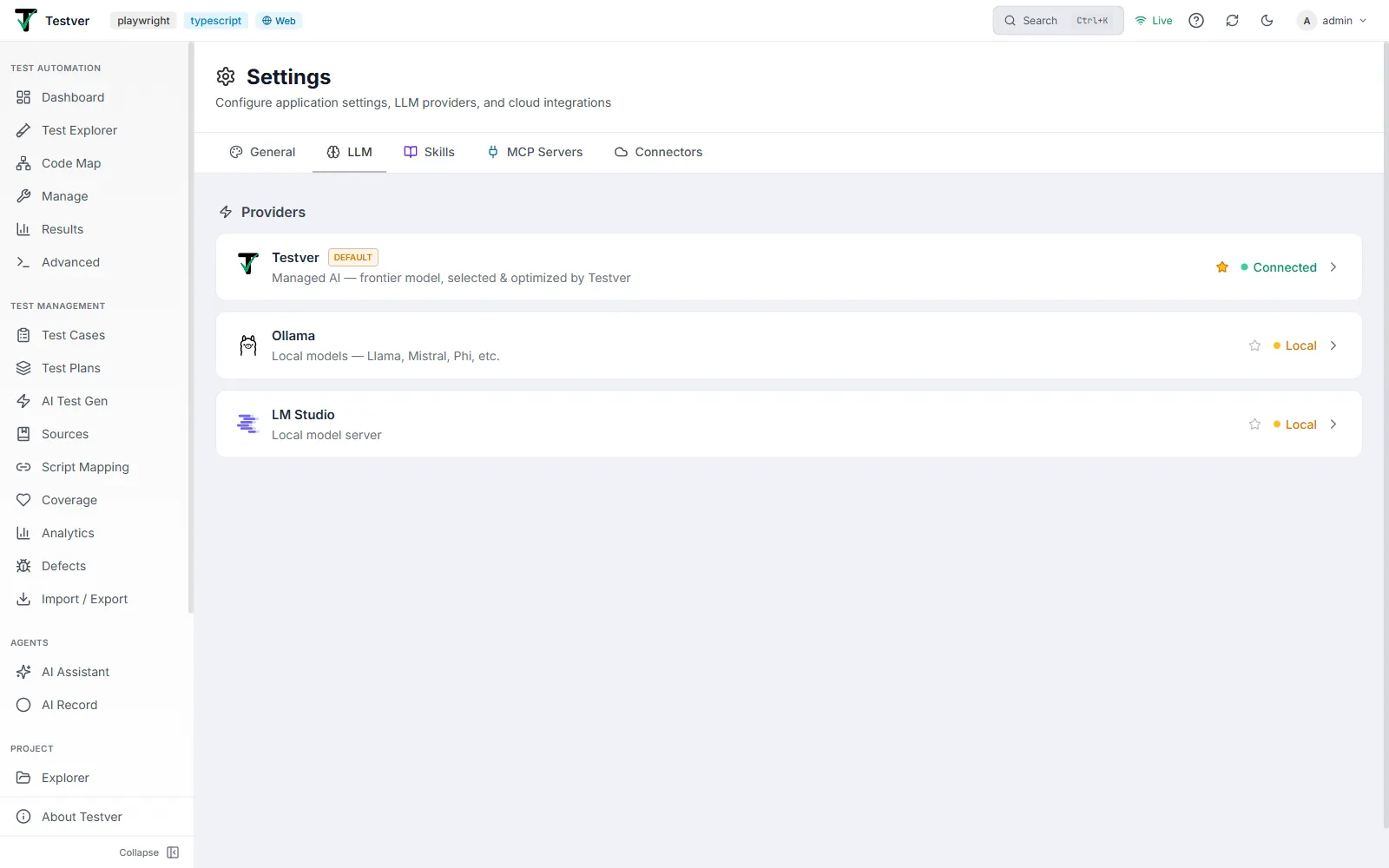
Each provider appears as an expandable card showing its name, a short description, a status indicator, and a star marking the default provider. Click a card header to expand its configuration form.
| Provider | Kind | Models / role | Needs a key? |
|---|---|---|---|
| Testver | Cloud | Managed AI — a frontier model selected and optimized by Testver | Connect your Testver account on Testver → Connections; the card shows the status |
| Ollama | Local | Local models — Llama, Mistral, Phi, etc. | No |
| LM Studio | Local | Local model server | No |
Testver is the only cloud provider. You do not bring your own OpenAI, Anthropic, Google, or xAI key — Testver supplies the cloud model itself, already selected and tuned for test automation work. That means no third-party model account to create, no per-vendor keys to rotate, and no decision about which model to pick.
The two local providers are unchanged: they run entirely on your own machine, cost nothing per token, and send no data anywhere.
Who sees which providers
Section titled “Who sees which providers”| Role | Providers shown |
|---|---|
| Any user | Testver |
| Administrator | Testver, plus the local providers (Ollama, LM Studio) |
So if you’re not an admin and the LLM tab shows only the Testver card, that’s expected — local providers are an administrator-level configuration.
The Testver card
Section titled “The Testver card”Expand the Testver card to see the connection status, your current plan and remaining credits — the same figures as your testver.com dashboard — plus the model settings. Connecting and disconnecting happen in one place, Testver → Connections (the pinned entry at the bottom of the sidebar); the card links there. One connection there switches on every Testver service your plan includes: AI credits, Testver Grid and Testver Mail.
Provider status — the colored dot and label on each collapsed card tell you how the provider is configured:
| Status | Meaning |
|---|---|
| Not Configured (gray) | No key or settings saved for this provider yet. |
| Configured (green) | An API key has been saved in Testver’s config. |
| Env Var (green) | The API key is supplied via an environment variable rather than typed into Testver. |
| Local (amber) | A local provider (Ollama / LM Studio) that runs models on your own machine. |
Default provider — the star icon on each card header sets that provider as the workspace default. The current default shows a filled amber star and a DEFAULT badge. Clicking the star on another provider switches the default immediately.
Configuring a provider
Section titled “Configuring a provider”Expanding a provider card reveals its full form. The exact fields depend on whether the provider is cloud (needs a key) or local.
| Field | What it does |
|---|---|
| API Key | The secret key authorizing calls to the provider (cloud providers only). Hidden by default; use the eye toggle to reveal it. A saved key shows as dots with a (saved — click to change) hint. If the key comes from an environment variable, a note names the variable instead. |
| Models | The provider’s model library, shown as chips. Click the star on a chip to make it the active model; click the X to remove a model (when more than one exists). |
| Add model input | Type a model name and press Enter or click + to add it to the library. The placeholder suggests the provider’s default model. |
| Base URL | The API endpoint. Optional for cloud providers (defaults to the cloud endpoint) and required for local providers. The active and default URLs are shown beneath when relevant. |
| Timeout (ms) | How long to wait for a response, in milliseconds. Leave blank for the default — 60s for cloud providers, 5 min for local providers. |
| Test Connection | Pings the provider with the current key/URL/model and reports success or failure along with the response latency in milliseconds. |
| Save <provider> | Persists this provider’s API key (only if newly entered), model library, active model, base URL, and timeout — plus any pending default-provider change. |
Related
Section titled “Related”- Settings overview — the other tabs on this screen.
- First-time setup — connecting a provider during your first run.
- AI Assistant — the main consumer of whichever provider you connect.
- Skills & MCP — extend what the AI knows and can reach.